

Every year, a select group of Heisman Trophy voters go rogue. Out of nearly a thousand ballots, a few decide a player nobody else is talking about deserves the top spot on their card. It likely happens more often than we notice, since only the top 10 vote-getters are ever released to the public.
Heisman ballots only have three spots. The vast majority of voters land on the same handful of names, with varying order among the finalists. But scroll to the bottom of most yearly results and you will find at least one player who made the top 10 with just a single first-place vote to his name.
Since 2000, 24 players have made the Heisman top 10 while receiving exactly one first-place vote. Below are the 10 with the lowest final point totals of that group. That's not the same as the lowest totals in that span. Players well outside the top 10 have picked up a first-place vote or two of their own over the years, but that information was never made public. These are simply the lowest totals among the players we actually know finished in the top 10.
Some of these picks at least have an argument that they were deserving of spot on a ballot. Others really don't. Either way, some Heisman voter looked at the entire sport that year and picked the one name nobody else did.

DeAngelo Williams, Memphis
| Year | Place | 1st | 2nd | 3rd | Total |
|---|---|---|---|---|---|
2005 | 7th | 1 | 2 | 19 | 26 |
The 2005 vote is remembered as one of the most lopsided in Heisman history. Winner Reggie Bush earned the second-highest percentage of possible points (91.8%) and the fifth-highest first-place votes (784) ever. The other finalists were Vince Young and Matt Leinart, with a vast majority of voters seeing a clear 1-2-3.
Yet one ballot skipped past all three and put Memphis running back DeAngelo Williams at the top. He led the FBS with 1,964 rushing yards and ranked fourth with 18 rushing touchdowns, but his 6.3 yards per touch paled next to Bush's absurd 9.4. Also, Memphis finished 6-5 in the regular season, while USC and Texas met in one of the all-time great national championship games. And this isn't even the most indefensible first-place vote from the 2005 race (more on that later.)

Jonathan Taylor, Wisconsin
| Year | Place | 1st | 2nd | 3rd | Total |
|---|---|---|---|---|---|
2018 | 9th | 1 | 2 | 19 | 26 |
In 2018, the top six finishers in Heisman voting were all quarterbacks, something that had only happened once before in award history, in 2001 (it would happen again in 2022). In most other years, Jonathan Taylor gets more love. His 2,194 rushing yards, including the bowl game, rank eighth-most all-time.
Wisconsin opened the season No. 4 in the AP poll but finished unranked. If the Badgers had been a playoff contender, Taylor would have been at least a finalist. Instead, the conversation belonged entirely to eventual winner Kyler Murray, runner-up Tua Tagovailoa and the late Dwayne Haskins. Somebody, though, wasn't ready to let a season that good go unrewarded.

Ken Simonton, Oregon State
| Year | Place | 1st | 2nd | 3rd | Total |
|---|---|---|---|---|---|
2000 | 9th | 1 | 5 | 12 | 25 |
West Coast bias is the easiest explanation for whoever put Ken Simonton at the top of their ballot in 2000. Oregon State had a special year, with Simonton powering the Beavers to an 11-1 record and a Fiesta Bowl blowout of Notre Dame. But he wasn't even the best back that season. Finalist LaDainian Tomlinson led the FBS in rushing yards, and Simonton didn't crack the national top five in any major rushing category. Chris Weinke, Florida State's national championship quarterback, won the award. Somebody watching out west clearly disagreed with the rest of the country.
Tua Tagovailoa, Alabama
| Year | Place | 1st | 2nd | 3rd | Total |
|---|---|---|---|---|---|
2019 | 10th | 1 | 4 | 13 | 24 |
The year is an important context here. Tua Tagovailoa was the Heisman runner-up in 2018, and there was a real argument he'd have contended for the trophy outright had he played a full season in 2019. However, he missed three games because of injury. He was on pace to blow past his 2018 numbers, so there's a case there perhaps, until you consider who actually won in 2019.
Joe Burrow garnered the second-most first-place votes (841) and the largest margin of victory (1,846 points) in Heisman history. Even if you projected Tagovailoa's pace to match the 15 games Burrow played, he's still behind what the LSU quarterback did in that historic offense.
J.J. McCarthy, Michigan
| Year | Place | 1st | 2nd | 3rd | Total |
|---|---|---|---|---|---|
2023 | 10th | 1 | 7 | 4 | 21 |
Three players in the top 10 of the 2023 Heisman vote received just one first-place vote, so there were a handful of throwaway picks. Ollie Gordon II and Cody Schrader were two of them, while J.J. McCarthy was the third, squeaking into 10th place. The difference is that Gordon and Schrader were viewed as two of the best running backs in the country that year, while McCarthy ranked as just the sixth-best quarterback on the final tally.
Some years, the award simply goes to the quarterback on the best team, and Michigan did win the national championship. But McCarthy's 2,991 passing yards and 22 touchdowns were hardly in the same universe as LSU's Jayden Daniels, who threw for 3,812 yards and 40 touchdowns while also rushing for 1,134 yards and 10 additional scores during a record-setting Heisman campaign.
Drew Olson, UCLA
| Year | Place | 1st | 2nd | 3rd | Total |
|---|---|---|---|---|---|
2005 | 8th | 1 | 2 | 14 | 21 |
We hinted there would be more from the 2005 Heisman vote at the top of this list. Drew Olson put together one of the best single seasons by a UCLA quarterback that year, throwing a school-record 34 touchdowns against just six interceptions while leading the Bruins to a 10-2 record. But UCLA did get blown out 66-19 by a USC team led by Heisman winner Reggie Bush and finalist Matt Leinart. The gaudy touchdown total apparently mattered enough to at least one voter, who put Olson at the top of their ballot ahead of all three Heisman finalists.

Chris Long, Virginia
| Year | Place | 1st | 2nd | 3rd | Total |
|---|---|---|---|---|---|
2007 | 10th | 1 | 2 | 10 | 17 |
It's extremely rare for a defensive player to win the Heisman Trophy. Only Charles Woodson and Travis Hunter have pulled it off, and both also contributed significantly on offense or special teams. There have been plenty of outstanding pure defenders over the years, but it usually takes a truly Herculean effort for one to be seriously in the Heisman conversation. Not to knock Chris Long, who tied for third nationally in sacks (14.0) and tied for 10th in tackles for loss (19.0) in 2007. That's an excellent season for a defensive end, but it's not the kind of production that typically registers Heisman buzz. One voter, though, decided it did, putting him at the top of their ballot in a year when Tim Tebow and Darren McFadden were the obvious top two finishers.

Bryce Petty, Baylor
| Year | Place | 1st | 2nd | 3rd | Total |
|---|---|---|---|---|---|
2014 | 10th | 1 | 3 | 4 | 13 |
Now we're at a point where few voters had these players on their ballot at all, let alone at the top. Bryce Petty appeared on just eight ballots total. His numbers were far less productive than Oregon's Marcus Mariota, who ran away with the award and finished with the fourth-highest first-place vote total (788) ever.
Also, Petty wasn't even considered the best quarterback in the Big 12 that season, with TCU's Trevone Boykin finishing fourth in the Heisman tally. You can make the argument that Baylor was snubbed from the College Football Playoff in 2014, but Petty's Heisman case wasn't.
Trevone Boykin, TCU
| Year | Place | 1st | 2nd | 3rd | Total |
|---|---|---|---|---|---|
2015 | 10th | 1 | 3 | 4 | 13 |
Trevone Boykin entered the 2015 season as the preseason Heisman favorite, coming off a fourth-place finish the year before. He still put up a strong season for TCU, throwing for 3,575 yards and 31 touchdowns, but the race ran away from him -- literally. Five running backs finished with a higher final voting total than Boykin, with winner Derrick Henry ahead of runner-up Christian McCaffrey. Deshaun Watson was the only quarterback among the three finalists, leading Clemson to the national championship game. Somewhere in that pileup, one voter kept the faith in the preseason favorite and apparently never bothered updating their ballot.
Javon Ringer, Michigan State
| Year | Place | 1st | 2nd | 3rd | Total |
|---|---|---|---|---|---|
2008 | 10th | 1 | 0 | 5 | 8 |
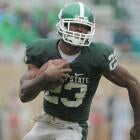
Javon Ringer has the lowest Heisman voting point total (8) of any player to make the top 10 since 2000, and the breakdown shows just how thin his support was. Five third-place votes, no second-place votes and one lone first-place vote from someone who saw something nobody else did. In a year when quarterbacks dominated the top of the ballot, including Heisman winner Sam Bradford throwing for 50 touchdowns, a workhorse running back would have a difficult time cracking the top of anyone's card. Even Iowa running back Shonn Greene received just five first-place votes with more than 200 more yards rushing than Ringer had.