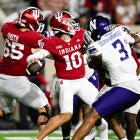


The Indiana Hoosiers came into the 2026 season knowing their biggest question would be at the quarterback position.
After Fernando Mendoza won the Heisman Trophy while leading Indiana to the national championship, there were awfully big shoes to fill in Bloomington and Curt Cignetti spun the transfer portal quarterback wheel once again and brought in Josh Hoover from TCU.
Hoover was always an interesting choice for the Hoosiers, as he was a high-variance quarterback for the Horned Frogs -- which represented a departure from the stability and consistency Mendoza provided. In 36 games with TCU, Hoover completed 65.2% of his passes for 9,629 yards with 81 touchdowns and 33 interceptions. The highs were high, but the lows could be incredibly frustrating in Fort Worth.
High expectations for Hoover
Given the way Cignetti's last two transfer quarterbacks -- Mendoza and Kurtis Rourke -- performed and improved with Indiana, most gave him the benefit of the doubt that he would be able to get the best out of Hoover while reining in some of his gunslinger tendencies. However, after No. 5 Indiana survived a scare from Northwestern in a 29-23 victory Friday, we've yet to see it fully click for Hoover and the Hoosiers' passing attack, despite Indiana boasting one of the best receiving corps in the country.
Against North Texas and Western Kentucky the offense took time to get warmed up before eventually pulling away, but in neither game were the Hoosiers ever in peril. But against Northwestern, a similar slow start nearly cost them, as Aidan Chiles caught fire in the second half to carve up the typically stout Indiana defense and created real stress for the Hoosiers.
Hoover's performance against Northwestern raised some red flags about his ability to get Indiana to that ceiling. His raw stats weren't bad -- 19 for 29 for 201 yards and one touchdown, with a rushing touchdown as well -- but the aerial attack was not consistently threatening and that was part of the reason the Wildcats were able to hang around deep into the fourth quarter.
The flashes of brilliance remain from Hoover. He orchestrated two long drives in the second and third quarters where he was in rhythm and picked apart the Northwestern defense, taking advantage of the skill gap between his star receivers, Charlie Becker and Nick Marsh, and the Wildcats' secondary. Some of his back shoulder throws to Becker in particular harkened back to what we saw a year ago from this Hoosiers offense.
Josh Hoover connects with Charlie Becker for a 23-yard gain to move @IndianaFootball inside the 10 💪 pic.twitter.com/3wgV3wnBD7
— FOX College Football (@CFBONFOX) September 26, 2026
However, those advantages should've been apparent all game, but Hoover wasn't able to consistently deliver the ball to his playmakers on the outside. Of his 19 completions in the game, 10 of them came on those two drives -- which yielded 10 of Indiana's points A year ago, Mendoza would ruthlessly attack the weak point of an opposing defense, identifying whichever of Becker, Omar Cooper and Elijah Surratt had the mismatch and exploiting it over and over.
To this point, Hoover hasn't shown that same kind of consistent efficiency.
Hoosiers need consistency out of Hoover
On Friday night, Lee Beebe Jr. bailed the Hoosiers out with a dominant second half rushing performance after Turbo Richard went down with an injury, breaking loose for multiple long runs to set up scores to keep Indiana in front.
The upshot of that is Indiana's running game is strong enough they don't need Hoover to be sensational in order to win. However, with Richard's status uncertain going forward and Khobie Martin out until midseason with an arm injury, the Hoosiers don't want to have to ask Beebe to run the ball 24 times in order to win -- especially against teams like Northwestern.
That means Hoover has to be more consistent. The flashes are fantastic, but what separated Mendoza last year was his ability to execute the mundane. Keeping the offense on schedule -- which in turn keeps the defense fresh -- is what Indiana wants to do. The explosive plays build off of that, but they aren't a team that's trying to be boom-or-bust.
Indiana's coaching staff has their part to play in this as well. Hoover is, quite obviously, a rhythm passer -- as evidenced by Friday's performance where more than half of his completions came on two drives. Once he completes a couple throws, he tends to get hot and can start hitting those downfield passes that make Indiana's offense dynamic. The Hoosiers need to identify the concepts that he's most comfortable with and lean on those early on drives to establish that rhythm and feel that he can ride.
The next two games at Rutgers and at Nebraska will provide more data points on whether Hoover is capable of orchestrating the offense at the level of efficiency Indiana fans grew to expect last year -- the Rutgers defense in particular should be exactly what the doctor ordered to build some confidence for Hoover. After that, the ultimate test will arrive in the form of a visit to Bloomington from the No. 7 Ohio State Buckeyes, where Indiana can't afford to be either one-dimensional or inconsistent if they want to maintain their perch as the Big Ten's top team.
It's too early to definitively declare Hoover isn't capable of leading the Hoosiers to a national title defense, but after that Oct. 17 clash with the Buckeyes, we ought to have a much clearer answer.