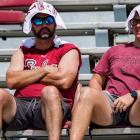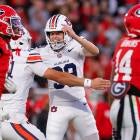


It's not the heat, it's the humidity. Actually, it's the heat too.
A blistering heatwave is affecting Week 1 of college football across the country. Teams everywhere are dealing with scorching temperatures, and they've directly impacted at least two contests so far.
Down in Columbia, South Carolina, the fourth quarter of South Carolina's season-opener against Kent State was trimmed to 10 minutes due to extreme heat. The temperature at Williams-Brice Stadium reached triple-digits on Saturday afternoon, and the feels-like temperature approached 110 degrees.
Roughly 1,000 miles away in Topeka, Kansas, a D-II game between Washburn and Colorado School of Mines was cut short because of the heat. The Ichabods and Orediggeers went into overtime tied at 16-16, but the game ended there because the temperatures were approaching dangerous levels.
It should also be noted that Washburn and Colorado School of Mines chose to start the game early to avoid the heat, but it didn't matter once the game went past regulation. It was Washburn's first tie since 1977.
While the early slate of games was brutally hot, the afternoon games were even worse at kickoff. For instance, the kickoff for Georgia's season opener against Tennessee State was at 100 degrees, making it the hottest game in program history.
It's 100 degrees at kickoff at Georgia. It's the hottest game in the Bulldogs' history, per the SEC+ broadcast.
— Brandon Marcello (@bmarcello) September 5, 2026
The National Weather Service issued a Heat Advisory for both Austin, Texas and Knoxville, Tennessee, where the heat indexes are expected to approach 105 degrees. The Longhorns and Volunteers are hosting their home openers in excruciating heat.
At times like these, a hydration chart would come in handy for players and coaches alike.
Of course, those temperatures don't fully account for exactly how hot it is inside the stadium and on the field. The turf at Skelly Field, where Tulsa is playing its first game of the season against Oklahoma State, hit temperatures in excess of 150 degrees.
Update on temp! pic.twitter.com/FyqT7So5mN
— Jeremie Poplin (@jeremiepoplin) September 5, 2026
College football fans will probably just have to get used to the heat moving forward. Last week, the NCAA approved a new FBS calendar that begins the season one week earlier, on what is currently Week 0. If that calendar is approved by the Division I Cabinet at its October meeting, it will go into effect for the 2027 season.
For now, stay hydrated and pack plenty of sunscreen. October weather will be here before we know it.