The College Football Playoff's 12 teams all had great seasons, but none are without a fatal flaw
The one thing that could upend any hope of a national title run for all 12 CFP contenders

By definition, every single team in the College Football Playoff has had a successful season. Five of these teams won their conference, and the other seven finished among the 10 best teams in the country in the eyes of the selection committee. Every team in the field has won at least 10 games, and there are plenty of reasons to believe at least a handful of those teams have a decent shot to make a deep run with a chance to win it all.
But there is not one team, even the undefeated No. 1 seed Indiana Hoosiers, that is perfect. Every team in the CFP has flaws, and the only question is whether those flaws end up being detrimental when it comes to their ability to advance out of each round in the bracket. Sometimes these flaws are of the self-inflicted variety, or things that teams can prevent with proper game-planning and execution. Other times the issues are totally out of their hands and will be left to the unknown of competition to see if they become a factor in a game. In every sense, these flaws are central to the conversation of the playoff and our understanding of how these teams will match up against each other.
We have taken some time to analyze all 12 teams, from No. 1 seed Indiana to No. 12 seed James Madison, and identify what could be the flaw that costs them their chance to win a national championship. In some cases it might be an issue that arises right away, but in others it could be more existential and something to monitor through the postseason.
So while all of these teams are great, and capable of making noise in the CFP, none of these teams are without a concern point that should be noted as we prepare to get the first round going this weekend.

1. Indiana: Injury luck
Any national championship run usually requires some amount of fortune in your favor, either in the course of a pivotal game or with a circumstance related to the team. And after going 13-0, beating Ohio State in the Big Ten Championship Game and seeing Fernando Mendoza win the Heisman Trophy, there is no doubt that a national championship run is the expectation for Indiana.
Unfortunately, the confetti was still falling in Indianapolis when the Hoosiers got a potentially horrific twist of injury luck when defensive lineman Stephen Daley suffered a "serious" leg injury while celebrating with fans after beating Ohio State. A transfer from Kent State, Daley is tied for third on the team in sacks with 5.5 and leads the team in tackles for loss with 19.0.
Indiana takes great pride in its band of misfits that have come together for an all-time run, but now its depth will be tested in the College Football Playoff for the most unfortunate reasons.
2. Ohio State: Run game
The Ohio State Buckeyes are loaded up with talent, led by one of the top coaches in the country and rightly have been identified as the betting favorite to win the national championship, so it's worth mentioning that we are nitpicking when it comes to finding flaws. But when a team is elite in so many areas sometimes the average traits become the outliers, and in the course of a playoff run could be the flaw that is exploited.
For Ohio State, that average trait would be its rushing attack. It's not just that Ohio State ranks 44th nationally in yards per carry (4.69) when virtually every other aspect of the team checks in somewhere between "very good" and "elite," it's that sometimes the hard yards aren't coming easy enough in critical situations.
The late-season emergence of freshman Bo Jackson as a real difference maker appears to be addressing this issue, but red zone failures against Indiana suggest it could still be a crucial piece of the Buckeyes playoff run.
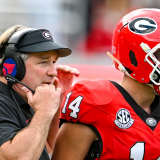
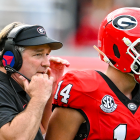
3. Georgia: Pass rush
Every Georgia defense from 2019 to 2024 averaged at least two sacks per game, but in 2025 the Bulldogs rank 101st nationally with 20 sacks on the season at a 1.54 sacks per game clip.
The defense as a whole has delivered good results, especially in the back half of the season, but it's a group that doesn't necessarily pose the same threats as previous Georgia teams in terms of having those game-breakers in the defensive front. Now it should be noted that this perceived flaw did not seem like much of an issue at all in wins against Georgia Tech and Alabama at the end of the season, but it's worth considering that those performances were also impacted by the opponent's flaws in the matchup.
Also, Georgia doesn't need recorded sacks to win the national championship but it does need to make sure that it can apply impactful pressure with the pass rush against the best passing opponents it will face in the playoff.
4. Texas Tech: Red zone offense
For a team that is so dominant, boasting 12 wins of 20+ points on the season, it does seem like the Red Raiders do leave a little bit of meat on the bone offensively when it comes to cashing in their scoring chances.
The numbers back it up, too, with Texas Tech ranking 101st nationally in red zone touchdown percentage (56.2%) and scoring touchdowns on just 32% of their red zone attempts across five games against FBS teams with a winning record.
When Texas Tech played its biggest games against its toughest opponents, the defense was dominant enough to produce a lopsided score but the margins could have been even larger if the offense had been able to punch it in the end zone more often.
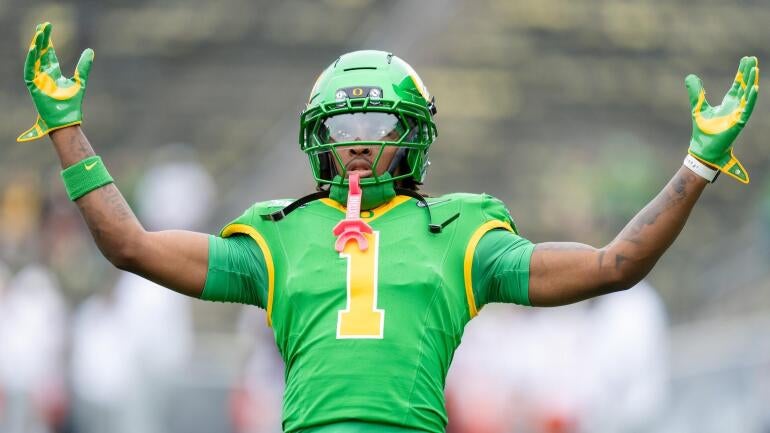
5. Oregon: Wide receiver injuries
Pretty simple one here, as one of the stories of Oregon's season has been the significant injuries on offense and in particular at the wide receiver and tight end positions.
It started with Evan Stewart's injury in the offseason and has continued with Dakorien Moore and Gary Bryant Jr. missing most of November and star tight end Kenyon Sadiq battling through midseason issues that included missing the Iowa game entirely.
The Ducks, to their credit, have had an impressive pivot to leaning on its run game and Dante Moore's play-making in key downs to control the game in wins against USC and Washington to close out an 11-1 regular season campaign. But if an opponent races out to an early lead and forces Oregon into a pass-heavy approach, the health and availability of its best pass-catchers will be a key to whether the Ducks can go deep in this bracket.
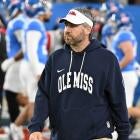
6. Ole Miss: Coaching transition
Pete Golding has said all of the right things and the vibe around Ole Miss has been pleasantly adaptable to the chaos of the last month as Lane Kiffin considered his future and ultimately departed for LSU.
The Rebels have just put together one of their best seasons in school history and now get to host a College Football Playoff game with a real opportunity to record the school's first ever CFP win. But what if the impact, and ultimately fatal flaw, is not tied directly to Kiffin but instead to confusion created by this cross-bred coaching staff. Members of Kiffin's future LSU staff like offensive coordinator Charlie Weis Jr. have returned to Oxford for the CFP, and Golding has made some LSU coaches the targets for his future staff with the Rebels. Oh yeah, and humming in the background is the potential for player movement between the two programs as well.
No one will know what Ole Miss' ceiling would have been without all this transitional and transactional chaos, but it's hard to think the current one is as high given all the noise around the games on the field.
7. Texas A&M: Run defense
If Texas A&M did a better job with defensive alignment and taking care of the football on Nov. 28 then the Aggies could have been a top-four seed in this College Football Playoff after going 12-0 and getting a shot at the SEC Championship.
Those are the margins that the Aggies were dealing with heading into the final weeks of the season, where the rivalry week loss to Texas now has Texas A&M down at the No. 7 seed staring down a challenging path to a national championship.
Like many teams here, we are nitpicking, but some of the issues defending the run that burned Texas A&M in the second half of the Texas loss were also issues that can be found elsewhere in an otherwise impressive 11-1 season. The Aggies ranked 13th in the SEC and 58th nationally giving up 4.03 yards per carry and even more concerning were the 58 run plays of 10+ yards given up on the year. Only Mississippi State (68) and Arkansas (80) gave up more 10+ yard runs among SEC teams, while fellow CFP participants Georgia and Oklahoma led the league in that stat.

8. Oklahoma: Offensive consistency
This fatal flaw unintentionally turns into a highlight of Oklahoma's greatest strength, because it speaks to how elite the defense has been that the Sooners were able to go 10-2 against one of the toughest schedules in the country with an offense that without a doubt was one of the most inconsistent among all power conference teams.
Unlike the rest of those groups, Oklahoma found just enough explosive plays to be able to get past tough opponents who were themselves bottled up by the defensive front.
A funny stat that brings my point home is this: Oklahoma wide receiver Isaiah Sategna III ranks second in the SEC in receiving yards per game (79.0) and fourth in receiving touchdowns (7) while the offense as a whole ranked 13th among 16 SEC teams in yards per play (5.37) and 12th in scoring averaging 26.4 points per game.
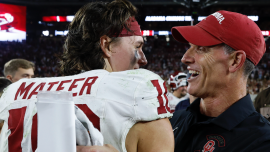
9. Alabama: Offensive drop-off
It's been nearly two months since Alabama has scored 30 points against an FBS opponent, and after getting totally bottled up by Georgia in the SEC Championship Game it's worth wondering whether the Crimson Tide can flip a switch before the playoff to find that early season form again.
Ty Simpson, at one point, looked like a Heisman Trophy contender as the general of a lethal passing attack that was carving up opponents, and to his credit he did finish with 26 touchdowns to just five interceptions and the second-most passing yards (3,268) in the SEC. But the inability to run the ball effectively was an issue that caused the rest of the offensive production to crater a bit coming down the stretch, and it makes the health of Jam Miller and the effectiveness of the offensive line a key to kick-starting any kind of playoff run for Kalen DeBoer's squad. Simpson himself does not seem fully healthy.
10. Miami: Interception avalanche
Miami quarterback Carson Beck was very good to close the year and enters the College Football Playoff coming off some of his best performances of the season.
Beck went 4-0 in his final four games, including road wins in Blacksburg and Pittsburgh, with 11 touchdowns to just one interception in that span and at least a 75% completion percentage in all four contests. But the season as a whole, and Beck's career, includes a couple of performances where interceptions piled up in a devastating way.
No one in the ACC threw more interceptions this season than Beck (10), and that follows a 2024 campaign with Georgia that saw him throw 12 picks in a six-game stretch. Six of Beck's 10 interceptions in 2025 came in Miami's only two losses (four against Louisville, two against SMU) and it makes taking care of the football crucial for the Hurricanes' chances of advancing in the school's first-ever College Football Playoff appearance.
11. Tulane: Defense
Jon Sumrall himself was not buying the midseason hype about Tulane as one of the best teams in the country, assessing a top-75 style rating for a group that was flirting with the top 25 of the rankings throughout the year.
So in line with his honest style we can keep this simple: Tulane was average defensively in 2025. The Green Wave ranked 62nd nationally giving up 5.49 yards per play and 50th nationally in scoring defense (22.6 points per game) despite playing a schedule that included a half-dozen teams that would rank in the bottom half of the entire FBS. They flipped the tables on a high-octane North Texas squad and got enough stops against Duke, but Ole Miss (which happens to be the team's first round opponent) scored on its first five drives and cruised to a 35-point win.
12. James Madison: Weight class
You can take this figuratively or literally, as James Madison will have a disadvantage in the trenches against Oregon in the first round but also has not played a schedule that includes any teams close to the level of a College Football Playoff contender.
A 28-14 defeat to a 7-5 Louisville team was the one blemish on JMU's otherwise stellar season, which saw the Dukes dominate the Sun Belt and absolute bludgeon even some of the best teams in their conference.
It's my personal thought that JMU, and other conference champions from outside the power conference structure, deserve a seat at the table for any playoff that is going to award a "national" championship. But it's also worth noting that JMU simply has not faced the types of teams that make up most of the playoff field and that alone could have wide-ranging impacts keeping the Dukes from winning it all.