

The college football regular season lasts 12 games (for now), which means every team in the nation has 12 chances to prove they're good or terrible. We then take the results of those games and try to find meaning in them.
For many of the games, the meanings are clear. When one team beats another by 40 points, it's rather clear which team was better, and while there might have been some bad luck involved in the final score, it's hard to argue that a team was unlucky when it lost by 40.
But there are many more games that feature final scores that are much closer. Remember last year when Notre Dame lost to Texas A&M and Miami by four points combined, and that was the definitive proof we all needed to knock the Irish out of the College Football Playoff and put Miami and A&M in? I'm not here to argue against the logic -- the results are the results, and when you start dealing with hypotheticals, things get murky. No, I'm here to point out that not every result is clear-cut, even if we tend to treat them all the same.
So, with a new season looming and all of us trying to figure out who will be good and who won't be, one of my favorite things to do is look back at all the one-score games from the season prior.
While a 12-game sample size isn't enough, if you look over the seasons, one-score games tend to be coin flips over the long run. The teams that tend to win them more often than not are the teams that win every game more often than not. The reason is that those teams rarely play one-score games! The more you play, the closer to .500 your record tends to be.
While it's not a perfect exercise, looking back at one-score games from the prior season often helps you identify teams that could see a reversal in luck in the coming season. Particularly when you do it in conference games where teams are theoretically playing in their weight class.
So, with that in mind, here are the teams that won the most one-score games in conference play last season.
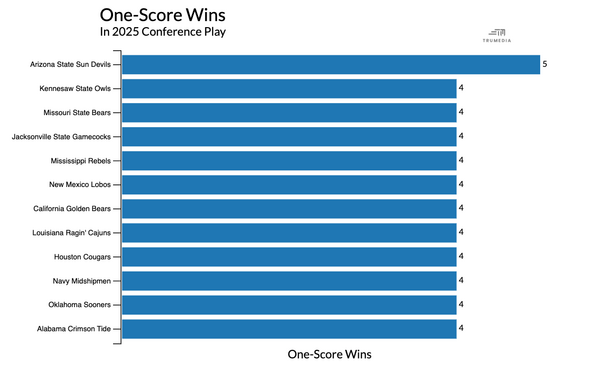
The Arizona State Sun Devils went 5-1 in one-score games last year during Big 12 play. As you can see, those five wins were more than any other team had, though there were plenty of teams that finished with four. Another thing worth mentioning is that, of the 12 teams listed in that graphic, Missouri State is the only team to have lost more than one such game. The Bears went 4-2. Every other team with four wins finished 4-0 or 4-1.
So how do we judge which of these teams were lucky and which were simply able to execute better in high-leverage situations? Well, we can't. What we can do, though, is look at how these 12 teams performed in a couple of areas that reflect lucky bounces to some extent. Here's a graph showing how they performed in point margin per game during those one-score games, and in points off turnover margin per game.
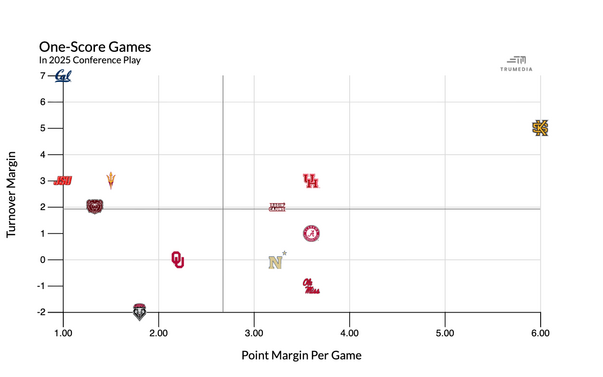
What should we make of this? Well, if we're looking for a "lucky" team, California certainly stands out! The Bears were 4-1 in these games with a +7 turnover margin, yet were outscored 150-145. Their lone one-score loss was an eight-point loss to Virginia Tech in double-overtime, while none of their four one-score ACC wins (Boston College, North Carolina, Louisville and SMU) came by more than four points.
Now is the part where I tell you Cal only won four ACC games. That's right, every single Cal win in conference play was by four points or fewer. Their four losses came by a combined 63 points. I'm not telling you this to say that the Bears didn't deserve to win those games, or that anything they did was a fluke. What I'm saying is that the difference between Cal being 4-4 in the ACC and 0-8 in the ACC wasn't great! There's a reason Cal fired Justin Wilcox and brought in Tosh Lupoi, after all.

Arizona State is in a similar boat. The Sun Devils went 5-1 in one-score games, but while they didn't get the same turnover luck Cal got (+3), they only outscored opponents 145-136 in those six games. That's an average of 1.5 points per game. The Sun Devils had an eight-point loss to Houston, but their wins over Baylor, TCU, Texas Tech, Iowa State and West Virginia all came by five points or fewer. Unlike Cal, though, Arizona State did have a multiple-score victory in the Big 12: its 42-17 beatdown of Colorado in Boulder.
Still, while I am a big-time believer in Kenny Dillingham, these numbers are another reason to be wary of the Sun Devils heading into 2026. This team lost Sam Leavitt to LSU and Jordyn Tyson to the NFL, and it wasn't like they were blowing teams out with both.
There are also reasons to be wary of Alabama, Houston, Oklahoma and Ole Miss. As for the G6 schools, honestly, I wouldn't dismiss any of these results, but given how the portal forces G6 teams to overhaul their rosters every season, I don't know how much useful information there is to glean from these numbers. The results of those leagues could prove to be far more random in any given season moving forward, but for a whole bunch of different reasons.
Now for the other side of the coin. After all, if some teams may have been lucky, somebody had to be unlucky. Here are the teams that lost the most one-score games in conference play last season.
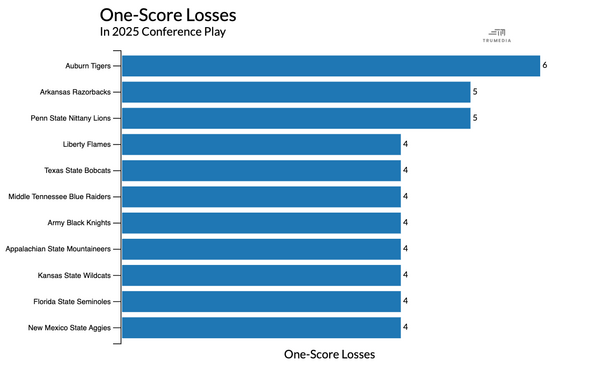
Much like the case with the wins, there aren't many two-win teams here, either. Of these 11, Army is the only one to pick up two one-score victories. Auburn, Arkansas, Florida State and Texas State didn't have any.
So were they unlucky or just bad? Let's break it down to points and turnover margins again.
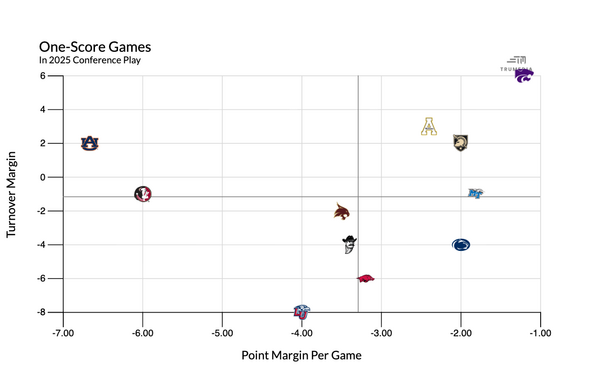
Look at Kansas State! The Wildcats went 1-4 in one-score Big 12 games with a turnover margin of +6! Nobody else in this group of 11 teams had a turnover margin better than +3. Making things worse, the Wildcats were outscored by six points in those five games, or 1.2 points per game. They had a 14-6 win over Oklahoma State and four losses of six points or fewer. I see those results, and I don't think Kansas State was unlucky. I think Kansas State shot itself in the foot and didn't execute.
But maybe that's where things turn around. Collin Klein has returned to Manhattan to take over the team, and it looks as though he's inheriting a team that was pretty good last year but was its own worst enemy too often. The Wildcats finished 6-6 overall and 5-4 in the Big 12, so all four of their conference losses were close. The same cannot be said of their wins, as the 'Cats beat UCF, TCU, Kansas, Oklahoma State and Colorado by an average of 14 points.
Based on the numbers we're looking at, there's an argument to be made that Auburn was the unluckiest team. It had a positive turnover margin in these games, but not to the ridiculous extent Kansas State did. The Tigers went 0-6 in these games, with their lone two-score conference loss being a 20-10 defeat at Georgia. So even that loss was close.
However, I don't think this was about luck as much as I think it was about a horrific offense. The reason Auburn was in so many close games last year was its phenomenal defense, which kept games close. At the same time, there was the wild 45-38 overtime loss to Vanderbilt, but the Tigers' defense didn't allow more than 27 points in any other SEC game. The offense just couldn't score any damn points of its own to win these games. That's why Alex Golesh is in charge now. So if the Tigers do rebound in 2026 and improve upon their 1-7 mark in the SEC, it'll likely be due to an improved offense, not the luck evening out.
Sticking in the SEC, I want to touch on Arkansas, but for entirely different reasons. I mentioned earlier in this story that luck tends to even out for teams over time. Well, there are exceptions, and Arkansas is one of them.
In the College Football Playoff era (since 2014), 44 of Arkansas's 98 SEC games have been one-score games. The Hogs are 10-34 in those games. That .227 win percentage is the worst of any team in the country in that time by a country mile. The next worst is East Carolina at .286 (8-20), followed by Nebraska at .298 (17-40).
For Arkansas fans, close games are nothing but heartbreak. The good news is that if luck truly does even out for everybody in the long run, there's a national title run in Arkansas' future, with the Hogs going 15-0 and outscoring opponents by 20 points combined.