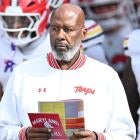
Mike Locksley became the first coach fired this season as Maryland made the call to move on Wednesday. But while October is still early to fire a coach, it actually bucks the recent trend.
This time last year, there had already been seven FBS coaches fired. Five Power Four coaches were gone by the end of September, with heavy hitters like Penn State's James Franklin, LSU's Brian Kelly and Oklahoma State's Mike Gundy out by October. In all, 30 jobs changed hands in 2025.
In many ways, the barrage of firings was the dying embers of an old era.
For one, there weren't enough high-level candidates to fill the spots. Michigan hired a stopgap in Kyle Whittingham, and he's floundered. Arkansas whiffed on several choices, and settled for Ryan Silverfield. Penn State missed out on Kalani Sitake and finally had to convince Matt Campbell to leave.
Furthermore, college football has changed. While a new coach can help take a program to new heights, pure resource deployment is suddenly the most important factor in the sport. With rosters clearing $30 million regularly, burning a $20 million buyout and having to hire a whole new staff and roster are becoming prohibitive costs.
In response, we've seen multiple programs try to change their administrative structure to adjust to the new era. Oklahoma and USC rank among programs that hired independent general managers who could realistically last through multiple coaches. It makes for a more NFL-style roster-building approach, where a coach is just one piece of the equation.
Last year, we also saw multiple programs try to invest more heavily in coaches to make it work: Wisconsin's Luke Fickell, Florida State's Mike Norvell and Baylor's Dave Aranda, chief among them. Fickell has likely saved his job with the performance, while Aranda and Norvell stay in varying levels of limbo. But still, a $10 million infusion into the roster could prove much more valuable long term than buying out and starting over.
Eventually, the market will reset, and we'll see more movement among coaches. It could even happen later this season. But with so much money invested in rosters, college football programs simply cannot afford to spend millions of dead money just to emotionally move off a coach.
With that in mind, who actually will be the next coach fired in college football? It's a complicated question.
The financially prohibitive
Candidates: Mike Norvell, Shane Beamer, Greg Schiano
When Shane Beamer's Gamecocks lost to No. 24 Kentucky on Oct. 3, it felt like the end. Beamer stood on the sidelines taking in every moment after the overtime loss, and looked defeated in the press conference.
Historically, that would be the final moment of an SEC coaching tenure. Instead, reports quickly came out that South Carolina wasn't likely to make a move and that finances were the primary driver. Beamer would be owed more than $22 million if fired after the season, a massive sum as South Carolina tries to fund a major college football roster.
The situation is even worse at Florida State, where Mike Norvell would be due nearly $50 million. Even for one of the most successful programs of the 21st Century, writing a check like that isn't realistic.
Maybe a donor comes forward to underwrite one of these buyouts, but it's hard to see that happening, especially midseason.
The complicated endgame
Candidates: Dabo Swinney, Deion Sanders, Lincoln Riley
All three of these guys are prohibitively expensive to fire, but separation could prove even more complicated than a simple separation agreement too.
Swinney is synonymous with Clemson, and the chances of finding a better coach are slim. Sanders has a brand of his own that's bigger than Colorado football, and an acrimonious divorce could cause fissures that last years to come. Riley has the most absurd contract of the bunch, but also has quietly investigated leaving most.
It's possible that any of these three figures will leave on their own or reach a mutual understanding, but it will be out of the athletic director's hands.
Will they pull the trigger?
Candidates: Dave Aranda, Dave Doeren, Bill O'Brien
All three of these coaches are clearly in the hot seat and could easily find themselves on the wrong side depending on how they close out the year.
Aranda's Bears are sitting at 4-2, but recorded an embarrassing 17-6 loss to rival TCU at home and close the year with BYU, Texas Tech and Houston. With the promise of this roster, and a manageable buyout, 7-5 won't cut it.
Doeren is 3-3, with a loss to Vanderbilt that continues to look worse, but the Wolfpack also upset Louisville. If he can get back to bowl eligibility, that might be enough, but donors could also be ready to move on. Will they invest enough to attract a better candidate?
The same is true of O'Brien, who has settled down after upsetting Pittsburgh a week ago. Find two more wins on a fairly manageable schedule, and he should be fine.
Played themselves off
Candidates: Bill Belichick, Jeff Lebby, Luke Fickell
North Carolina, Mississippi State and Wisconsin all decided to invest far more money into the programs during this cycle, and it paid off in a big way. The Tar Heels are 4-2 and gave both Clemson and Notre Dame tough games. There should be at least three more wins on the schedule.
Kamario Taylor completely changed the trajectory of Lebby's tenure at Mississippi State. The Bulldogs could push for eight wins with their schedule. Since the second half against Notre Dame, Wisconsin has looked the part during a 4-2 start. A loss to UCLA will stick in their craw, but there are at least four wins remaining too.
All three of these cases provide credence to the idea that changing the context around a coach can quickly turn fortunes.