

Bob Chesney's earliest memory of football traces back to the backseat of a car traveling through small-town Pennsylvania. As a high school coach, his father made Friday night games a community affair, with family members taking on distinct roles and a local neighbor volunteering to film.
Because he filmed the games, the neighbor was granted parking close to the stadium gate in Pennsylvania's coal country. Young Bob Chesney gripped his father's ballcap in the backseat, nervous they might not reach the stadium before kickoff while his dad, Bob Sr., patrolled the sideline.
"I would take his hat, and I would sit in the back and basically pray with it in my hand," Chesney said.
The moment the vehicle pulled into its spot, young Bob bolted toward the gate. He hurdled the barrier and charged down to the turf, where the squad warmed up. He embraced his father and handed him the ballcap.
Four decades later, father and son have reversed roles, and dad always shows up early.
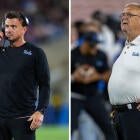
Bob Chesney Sr., 76, arrives at UCLA's football offices a little after 6 a.m. He goes home at 7 or 8 at night. He sits in staff meetings, works with the defensive line and hands out candy he calls "power pills." He doesn't have a title. He's not on the Bruins' payroll. But players call him Coach Senior, or just Senior.
"He's more like a grandfather to them right now, which is kinda cool that they all respect him," his son said.
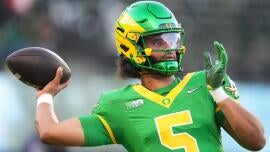
Saturday, Senior will be on the sideline at Autzen Stadium when No. 21 UCLA (4-0) plays No. 13 Oregon (3-1). It's the biggest test yet of Chesney's first season, in the same stadium where his James Madison run ended in the College Football Playoff last December, after UCLA had already hired him.
Bob Sr. has been there for nearly every step, every job, as his son has quickly risen through the coaching ranks, from Division III Delaware Valley to the Big Ten. Chesney has won everywhere and is on the cusp of becoming the first UCLA coach to start his career 5-0 in 77 years. He's won his first four games by 14 or more points, only the second Big Ten head coach to do so.
"It's just a matter of whose horse is gonna run the longest, that's all," Senior said.
One red light at the end of town
To understand the son, start with the town, the father and his lineage.
Kulpmont is a mile long and six streets wide, not counting the alleys. At one time, Bob Sr. said, it had 34 bar rooms and clubs, four shoemakers, a hat shop for women, a movie house and two lawyers. Men worked the mines, construction or the textile mill. Then the mines and mill closed, and people left. About 2,000 remain today.
"Small," Chesney said. "One red light at the end of town."
The mines took Bob Sr.'s grandfather, William Chesney, at 33. His wife, Clara, had three children and was pregnant with a fourth.
"The mining foreman brought my grandfather home, threw him on the porch and said, 'Clara, here's Bill, he's dead.' And that was it. No compensation," Bob Sr. said. "No insurance."
A widow with three children and another on the way. Times were tough. The oldest boy, Vincent, Bob Sr.'s father, took whatever work he could find to help the family. He became a bit of a pool shark, too.
The baby Clara carried was Edward. He grew up to be Bob Sr.'s godfather. Decades later, Bob Sr. and his wife, Claudia, named their second son Robert Edward. Their first, Vincent Michael, carries the names of both grandfathers. The youngest, Nicholas Peter, honors Claudia's grandfather and the doctor who delivered the boys.
"In our generation, names still had a purpose," Bob Sr. said.
The town raised the kids as much as their parents did. The Chesney brothers shoveled snow for the elderly in winter and cut grass in summer, and their father wouldn't let them accept money. Neighbors helped neighbors. They didn't take advantage of each other. Chesney ate lunch and dinner at friends' houses all over town.
"If you were a child of that town, you were really a child of almost everybody in that town," Chesney said.
"You could get a kick in the ass from anybody on the block if you were doing something wrong," Bob Sr. said. "And then they told your mom and dad. You got home, then your dad gave you another kick in the ass. The laws were black and white, and you're only a shoe away from getting a kick in the rear. So you sort of listened."
'Bobby was the show'
Bob Sr. knew he would coach by his sophomore year of college. Over Christmas break of his senior year, he dropped in on his old high school coach. Bobby Oravitz spotted him through the classroom window and came running to the back of the room. Bob Sr. started with the usual pleasantries.
"He said, well, let's cut the s*** and let's go, right down to the superintendent's office," Bob Sr. said.
Oravitz introduced him as the school's next teacher and assistant coach. That was 1971.
He started out teaching fifth and sixth grade. Elementary school let out later than the high school, so from September to December, he volunteered for every cafeteria duty and bus job to get to practice on time.
He later became head coach at Our Lady of Lourdes Regional, a small Catholic school in Coal Township, outside Shamokin. His son played for him for four years. Chesney's grandfather and uncle were on the staff, too.
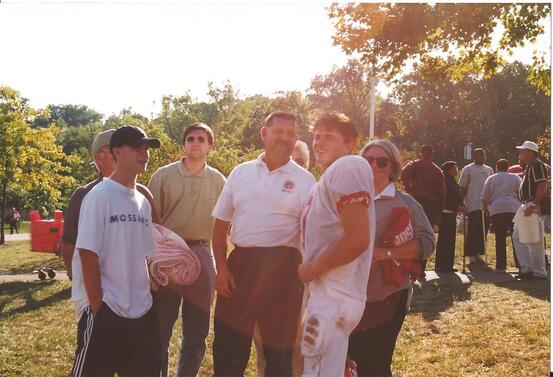
Lourdes had only 38 players. Most played offense and defense, pushing through pain, cramps and exhaustion that weakened them physically and mentally. It was just the way it was then, Bob Sr. said. Now he watches the highly skilled trainers at UCLA use Catapult tracking devices to determine when to dial back practice for individuals.
"We would have blown those Catapult things right off their chests," he said.
Chesney played quarterback, punted, kicked off and returned punts. In Bobby's four years, the team's best record was 6-5, but "Bobby was the show," Bob Sr. said. A few miles away, Mount Carmel Area played for state titles. His brother, Nick Chesney, attended school there and later won a state ring. The brothers reunited at Dickinson College during Bobby's senior year, Bobby at safety and Nick at corner.
Wins were scarce at Lourdes, but the community was strong.
"They knew the parents. They knew the grandparents. They knew the brothers and sisters. They knew the aunts and uncles," Chesney said. "They treated people the right way, and they were demanding as you possibly could be, but at the same point in time they thought of them as their own kids. That's a big piece of what we're doing here."
'I'm gonna coach'
At Dickinson, Bob Sr. cornered his son during Christmas break of his sophomore year and told him it was time to decide on a major. Religion, Bobby said.
"Well, I almost fell over," Bob Sr. said.
He told his son to pick something that would lead to a job.
"But he said, 'No, Dad, when I get out, I'm gonna coach,'" Bob Sr. said.
Chesney started at Norwich in Vermont as a graduate assistant, making $5,000 a year. He lined the field, sold tickets and even coached lacrosse. He went home in the summers for odd jobs. The raises came slowly: $24,000, $26,000, $28,000. He and Andrea, now his wife, moved to Baltimore for his coaching gig at Johns Hopkins, and he tended bar at a club called Kamp in the offseason to make extra money.
"I watched my dad work really hard in his life, you know?" Chesney said. "I watched him as a teacher, and then a football coach, and for very little money. We didn't have a lot growing up and sacrificed a lot."
In his seventh year of coaching, still earning about $30,000, he landed a role on "Cowboy U," a CMT reality show, after a friend at a Philadelphia casting company helped him make an audition tape. He spent 20-some days at a camp in the Colorado mountains with no electricity, cooking over a fire and competing in daily challenges. He refused to do the show unless he was allowed to wear his favorite Kulpmont T-shirt. He lost the final competition by two or three tenths of a second, he recalled. The prize was $25,000 or $30,000, he said, "which was basically what I made the entire year."
"I was making no money, but I was never gonna give up on this profession," Chesney said.
When he called home to say he'd gotten his first head coaching job, at Salve Regina in Newport, Rhode Island, his father had never heard of the place.
"I thought he joined the monastery or something," Bob Sr. said. "With that religion major."
But Chesney was well on his way. Salve Regina had eight straight losing seasons before he arrived, and he flipped it to three consecutive winning seasons. Then came Assumption College and five straight winning seasons. He moved up to Holy Cross in 2018 and became the first coach ever to win five straight Patriot League titles. When Curt Cignetti left James Madison for Indiana, Chesney took over, reloaded the roster and won the school's first bowl game. In his second season, he went 12-2, won the Sun Belt championship and took JMU to the program's first playoff game.
"He did it one rung at a time. He didn't skip anything," Bob Sr. said.

Purple papers
Over those 24 years, Bob Sr. attended nearly every preseason camp, walked the sidelines, helped players with their troubles and offered instruction to defensive linemen when they needed it.
One day at Holy Cross, Bob Sr. found a stack of old purple mimeograph papers in his son's office. They were his: special teams sheets and scouting notes he had handed out as a high school coach, each with his sayings printed on it. His son had kept them through college and three head coaching jobs.
"My practices were like the first coat of shoe polish that you put on your shoes," Bob Sr. said. "Later on, you spit-shine it. My degree in coaching is a bachelor's. He's working on a triple doctorate with all the stuff that he knows and does. I was just an old rock head coach."
NFL scouts, he said, come back to Chesney's practices just to observe the flow.
"If a segment says it's three minutes, it's three minutes," he said.
Can this guy help us beat Oregon?
The first call about UCLA came from Casey Wasserman, a successful sports and entertainment talent agent. The process started earlier, Chesney said, when friend and sports media star Bill Simmons looked over UCLA's first list of candidates during the fourth week of JMU's season and asked Wasserman why Chesney wasn't on it.
As JMU kept winning, his name kept coming up.
Chesney saw an athletic department loaded with national champions, first-round picks and Olympians.
"But we're one good football team away from possibly being the most dominant athletic department in the entire country, and that's the truth," he said.
Building that team started with a loss. After JMU fell 51-34 in the first round of the CFP at Oregon, every UCLA roster decision turned on one question, Chesney said: Can this guy help us beat Oregon?
So he brought people who had already been there. Running back Wayne Knight, who set JMU's single-season record with 2,039 all-purpose yards and earned All-America honors. Guards Riley Robell and Carter Sweazie. Landon Ellis, JMU's leading receiver last season. Edge rusher Sahir West. Defensive lineman Aiden Gobaira. He also hired coordinators Dean Kennedy and Colin Hitschler.
Kennedy was a young staffer on Dan Mullen's Florida staff looking to get his first full-time coaching gig, so he took mentor Garrick McGee's advice and handwrote letters to coaches across the country. He sent several hundred. Two coaches wrote back. One was Pat Fitzgerald, then at Northwestern. The other was Chesney, then at Holy Cross, who didn't simply respond with a form letter. He researched Kennedy's family, discovered Kennedy's father had died of ALS, and donated to Christmas in the City, the Boston charity Kennedy's parents founded, and another charity Kennedy had started for his father.
"At that moment I knew he was special and I didn't really realize until I started working for him how special he was," Kennedy said.
Chesney hired him soon after. Now he's calling UCLA's offense.

Coming out of hibernation
UCLA's new coaches know they're still in the honeymoon phase. Everyone loves them. The offense is on fire, the defense is doing enough to give them a chance, and the players who stayed behind at UCLA, including quarterback Nico Iamaleava, are finally experiencing the success they craved a year ago.
Chesney is the first UCLA coach to open his tenure 4-0 since Red Sanders in 1949.
"He's just elevated the coaching profession and the coaching ability in his own spirit, which transmits to the kids, which transmits to the program, which is radiated through the environment out into the community," Bob Sr. said. "Right now, the LA lights are flashing UCLA."
Two weeks ago at Maryland, four buses and a caravan of cars from Chesney's hometown of Kulpmont traveled to College Park and filled a section of the Terps' stands. They made shirts and signs and waited outside the locker room to support the town's favorite father and son. When it rained, Chesney said, they stayed. The Bruins won 54-3.
Coach Senior brings his own traditions. At every stop, he makes a sign that reads "Pride and Pads," and players touch it on the way out of the locker room.
When he arrived this summer, he started telling anyone who would listen that "the Bruins are coming out of hibernation and the Big Ten's gonna know about them." The equipment staff put it on a shirt.
He hands players Mentos and Skittles and calls them power pills. After a video of this habit made the rounds, boxes of Skittles began appearing at the football facility. He pokes at officials before games, asking if they've had their eyesight checked and if they have been drinking their carrot juice.
"I'm dippy," he said. "There's something wrong with me. … It's neat, not only with the administration tolerating it, but with the players tolerating it."
"Ah, he's the man. I love it," Kennedy said. "Great guy. If you ever need someone to sing a song, he's the one."
Yes, the vibes are high in Westwood. Chesney encourages coaches to bring their families to the office for meals and practices. Kids run through the hallways, filling the building with laughter. Bob Sr. and his wife, Claudia, found an apartment a quarter of a mile away, and he has free rein, regularly attending staff meetings and huddling with the defense.
"The communal nature of the human element and helping each other and being present for each other is probably one of the bigger lessons that I've learned from him," Chesney said.
Chesney asked his players this week to recommit to their process, the way they did on the first day of camp. UCLA is ranked for the first time since 2023, and complacency is a concern.
"There's a number next to our name now with a ranking, and if we pay attention to that number and admire that number, it will probably disappear," he said.
"He tells them just like I told him when he was a kid," said Bob Sr. "When you get up in the morning, you fix your bed. You don't get out of bed and leave the bed a mess. That way, you at least know you did something positive. If you go somewhere and someone asks if you did anything positive today, you can say, 'Yeah, I fixed my bed.'
"Positive attitude. He can't do anything with a negative attitude. If you're gonna just be humdrum, what the hell, you're just wasting time."
Back to Autzen
Life on the road is about to get much harder, and they know it. They've already seen what a trip to Oregon can mean, and it certainly won't look anything like the homecoming two weeks ago at Maryland. Last Dec. 20, Oregon jumped on JMU early and led 34-6 at halftime, but the Dukes outplayed the Ducks in the second half, finishing with 509 yards to Oregon's 514, outscoring the Ducks 28-17.
"It took us a minute really to catch up to their speed. It was just different than what we had anticipated," Chesney said.
Kennedy points to penalties (13) and two red-zone trips that ended in field goals. The Dukes played cleaner after halftime.
"It's about us, right?" Kennedy said.

The double sevens
The ball boy sitting in the backseat with his father's ballcap would think what Chesney has achieved is pretty cool, he said, "but remember how you got there."
"Well, the big thing is just to continue to be who he is. And I don't think he's ever gonna let this job go to his head. 'I'm a coach at UCLA and I'm a big s*** now.' I don't think that's gonna happen. He's gonna be Bob Chesney," Bob Sr. said.
Midway through a phone call, Bob Sr. stepped out of an office on UCLA's campus and onto a sunlit porch.
"I do get choked up about it. I'm an emotional guy," he said.
After games, the son shakes hands with the opposing coaches. And so does his father.
"Many coaches, when I shake their hands at the end, say, 'You don't know how much we envy you being with your son,'" he said.
When he wonders whether he should get out of the way, Claudia stops him.
"She said, no, those guys need you because they see the relationship you and Bobby have," Bob Sr. said.
But time is running out, he said. Chesney's mom and dad will travel across the country back to Pennsylvania after the season, ready to shovel snow and return to small-town life in a former coal town. Bob Sr. keeps telling Claudia this will be his last season beside his son. She isn't so sure.
"When I hit the double sevens, maybe I should cash out. But we'll see," said Bob Sr., who turns 77 in November. "I go to run now and my legs say, what in the hell are you doing? And then the lungs chime in. I have to put it in neutral."
So, on Saturday, UCLA's coach, a coal miner's great-grandson from a one-stoplight town, will be in Eugene, standing beside his father on one of the biggest stages in college football.
What does that mean to him?
"Well," Chesney said, "that he's my dad."