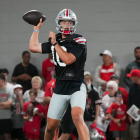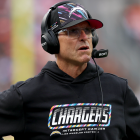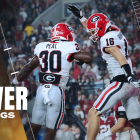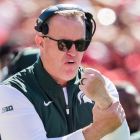


The Big Ten's preseason quarterback hierarchy starts with legitimate Heisman Trophy candidates, but certainty fades once the conference's top-to-mid-tier is settled.
There's star power leading the way, including proven winners and high-upside passers operating within championship-caliber offenses. Beyond that group, however, the league is a mixed bag packed with transfers, reclamation projects and talented players still searching for consistency.
Several programs believe they have found answers during the offseason, but many of those projections are based more on potential than production. That makes ranking the Big Ten's quarterbacks unusually difficult entering the 2026 season.
The difference between the middle and bottom tiers is narrow, and a few unexpected risers could completely reshape the pecking order once games begin later this month.
1. Julian Sayin, Ohio State
After putting together one of the most statistically efficient campaigns in Big Ten history, a seasoned version of Sayin gets an early test at Texas in Week 2. He proved in 2025 he can handle the pressure that comes with leading Ohio State; however, Sayin looked human during losses to Indiana and Miami behind a faulty offensive front. His accuracy, anticipation and command of the offense separate him from the league's other elite options after a 32-touchdown, 3,600-yard performance.
The transition to new offensive coordinator Arthur Smith brings schematic changes, but Sayin's experience and football intelligence should ease that adjustment. Smith's commitment to balance could make Ohio State more difficult to defend, too. Surrounded by premium talent, Sayin has every opportunity to emerge as college football's best quarterback.
2. Dante Moore, Oregon
Moore enters the 2026 season as one of the Big Ten's top quarterbacks after showing last fall why many believed he could become a future first-round pick. He chose to return to Oregon for one more season as one of the nation's highest-paid players, and Moore's combination of poise and downfield accuracy gives the Ducks an advantage at the position. Moore is comfortable attacking tight windows, and that's paramount while leading an offense centered around timing.
Like a few others in this ranking, he'll be adjusting to a new offensive coordinator this season, but schematic changes won't be noticeable. If Moore handles increased expectations, he has the tools to lead Oregon back to the College Football Playoff as a potential league champion.
3. Jayden Maiava, USC
Maiava flashed the arm talent and play-making ability Lincoln Riley covets at quarterback last season. He has grown more comfortable operating within the offense, and that confidence should translate into better decisions and increased consistency this fall. That starts with cutting down mistakes and not trying to do too much. Maiava can stretch defenses vertically, create outside structure and deliver from multiple platforms, giving the Trojans considerable upside offensively. If USC's receivers emerge as dependable options, Maiava has everything needed to become one of the nation's most productive and dangerous passers.
4. Malik Washington, Maryland
Washington gives Maryland legitimate hope after last season's 4-8 finish because young quarterbacks with his upside can change a program's trajectory quickly. He has the athleticism and confidence to create explosive plays even when everything around him is not perfect. That matters for a Terrapins team needing more consistency across the board.
Washington will make mistakes as he develops, but his ceiling is considerably higher than most quarterbacks in the Big Ten's middle tier. If Maryland protects him and its budding playmakers emerge, Washington has a chance to become a superstar and keep the Terrapins competitive.
5. Josh Hoover, Indiana
There may not be a signal caller facing more pressure to perform this season than Hoover, who is next man up at Indiana following Heisman winner Fernando Mendoza's greatness in 2025. Hoover feels like the perfect quarterback for Curt Cignetti's offense thanks to his extensive starting experience and quick decision-making. Those are traits Cignetti values within his system. Hoover has already produced at a high level at TCU and should benefit from Indiana's structure, protection and attention to detail. There may be an early adjustment period, but his skill set fits seamlessly.
6. Demond Williams, Washington
Williams belongs among the Big Ten's top quarterbacks because of the pressure he puts on defenses as a true dual-threat. He can attack downfield, escape collapsing pockets and turn broken plays into explosive gains, giving Washington an answer when protection fails. Williams' confidence and creativity separate him, but his continued development as a passer will determine the Huskies' ceiling. Williams has the talent to produce one of the conference's biggest seasons and push Washington into the playoff conversation.
7. Nico Iamaleava, UCLA
The time is now for Iamaleava to turn potential into production at UCLA. Playing for first-year coach Bob Chesney provides a fresh start, but patience could be limited for a quarterback once viewed as one of the nation's elite prospects. Iamaleava has the arm and IQ to elevate the Bruins immediately, but he lacked consistency last fall. If Chesney unlocks those traits, UCLA could surprise. If not, questions about Iamaleava's long-term trajectory will continue.
8. Bryce Underwood, Michigan
Underwood's potential could finally be unlocked at Michigan under first-year offensive coordinator Jason Beck, whose arrival should modernize an attack that lacked explosiveness last season. Underwood has every physical tool needed to become one of college football's most dangerous quarterbacks, including elite arm strength and mobility.
Beck's challenge is creating easier completions while allowing Underwood's natural play-making ability to take over. Michigan cannot afford to keep him confined within a predictable, run-based offense. If the Wolverines protect their prized sophomore and Beck maximizes Underwood's dual-threat skill set, a breakout season in Ann Arbor feels entirely realistic this fall.
9. Drake Lindsey, Minnesota
A 3:1 touchdown-to-interception ratio last fall as a first-year starter for the Golden Gophers was a great building block for Lindsey, who has extremely high expectations from those around the Minnesota program. Flying under the radar a bit nationally, Lindsey finished his first season with eight touchdown passes and no interceptions in November as it all came together late for him.
10. Rocco Becht, Penn State
Matt Campbell knows what he's getting in Becht, a game manager of sorts each of the last three seasons as Iowa State's starter. His 2024 performance was his best with 3,505 yards passing and 25 touchdowns, and getting back to that level of production is the goal with the Nittany Lions. It's rare to find this level of experience in the transfer portal, and given his familiarity with teammates who came over from his former program, Becht should feel at ease offensively.
11. Colton Joseph, Wisconsin
Joseph arrives at Wisconsin with an opportunity to stabilize an offense desperately needing consistent quarterback play. His mobility and competitive edge should give the Badgers a different dimension, particularly when protection breaks down and plays move outside structure. He rushed for 1,007 yards last season at Old Dominion with 13 scores to go along with 21 touchdowns through the air. Expectations should remain measured as he adjusts to a new system and Big Ten defenses, but Joseph was brought in to provide an immediate spark.
12. Anthony Colandrea, Nebraska
Nebraska's offense should look different with the former UNLV transfer at quarterback, a fearless playmaker capable of creating offense outside structure. His mobility and willingness to attack downfield give the Huskers a needed spark, but those aggressive instincts must be managed. Colandrea has to limit turnovers and avoid forcing throws when the first option disappears.
If Nebraska protects him and establishes balance, this unit could exceed expectations. The ceiling is higher with Colandrea, though his decision-making will ultimately determine how far the Huskers climb this fall.
13. Aidan Chiles, Northwestern
Chip Kelly could be exactly what Chiles needs after two largely disappointing seasons at Michigan State. Chiles' physical tools have never been the issue. He can drive the football, extend plays and pressure defenses with his legs, but turnovers and inconsistency stalled his development.
Kelly's quarterback-friendly system should simplify reads, create favorable matchups and put Chiles in position to play faster. Northwestern represents a reset without the previous expectations. If Kelly rebuilds his confidence and sharpens his decision-making, Chiles could finally become the dynamic quarterback many expected him to be when he initially impressed at Oregon State in 2023.
14. Katin Houser, Illinois
The ECU transfer has already handled the demands of leading a first-team unit at his previous stop and should bring immediate stability to the position. Illinois does not need Houser to force the issue or carry the offense every week. If he protects the football, distributes efficiently and converts timely third downs, the Illini should remain competitive. His veteran presence could be especially valuable once the Big Ten schedule intensifies.
15. Alessio Milivojevic, Michigan State
Milivojevic came on strong down the stretch last season, starting Michigan State's final four contests with seven touchdown passes, two interceptions and 246.5 yards passing per game. There was enough shown on tape and in practice to convince first-year Spartans coach Pat Fitzgerald that Milivojevic is the right man for the job in 2026.
16. Dylan Lonergan, Rutgers
The former Alabama and Boston College quarterback is now the starter for the Scarlet Knights after beating out AJ Surace in a competition that took longer than anticipated. Lonergan played in 10 games with nine starts last year for Boston College, posting a QBR that ranked 81st nationally. Eight of his 12 touchdown passes came over the first two games of the season, wins over Fordham and Michigan State. From there, Lonergan had four touchdowns and five interceptions for the campaign.
17. Ryan Browne, Purdue
Browne headlines an offense for the Boilermakers looking to snap an 18-game losing streak against Big Ten competition this season. That's part of the reason why he's at the bottom of these rankings after a nine-touchdown, 10-interception first campaign as QB1. Purdue must put Browne in position to succeed and not put 100% of the responsibility on his shoulders offensively.
18. Jeremy Hecklinski or Hank Brown, Iowa
The only program in the Big Ten to not yet name its starter as of Wednesday, the Hawkeyes are being plagued by inconsistency in practice at the moment. This suggests lingering uncertainty at the most important position on offense. Competition is supposed to sharpen both players, but the Hawkeyes need continuity and command to show up from one of them. If this battle extends into the season, Iowa risks another slow offensive start while its defense is again forced to carry the load.