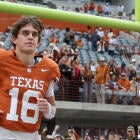


It's not an exaggeration to say that no quarterback in college football history has been consistently under the microscope like Arch Manning. Not Peyton or Eli. Not Tim Tebow. Not even Johnny Manziel. Much of that is a function of the world we now live in and, of course, that last name.
It's also not an exaggeration to point out that few (any?) high-profile quarterbacks have been so incredibly divisive. Watch Manning's best throws and it's easy to understand why he was frequently talked about as the top prospect in the class. Watch some of his worst decisions and you'll wonder how someone with his talent, experience – and last name – could continue making the same mistakes for two seasons now.
We've written this season about how Manning, at times, hasn't even resembled a first-round pick. We've also wondered whether returning to school for another year would matter. But we've reached the point where Manning will soon have to decide if he's taking his game to the NFL in 2027. And 247Sports' Chris Hummer reported last week that Manning's camp has made it clear among the industry that the expectation is Arch enters the 2027 NFL Draft.
That leads to this follow-up: Is Arch ready for the league … and is the league ready for him?
"I think he'd do himself a favor by going back to school, just because there's not really consistent games back-to-back-to-back," said the college scouting director for an NFL team. "You see the flashes. You see the fourth quarter against Ohio State. You see against LSU. There's a lot of 'wow' but there's also a lot of meh with him. You just want to see the consistency.
"It's almost unfair to the kid because if his last name was Johnson or Jacobs or some generic last name, he wouldn't have the undue pressure and the eye of everybody every Saturday. But yeah, I would love to see just more consistency to his game with like accuracy, pocket play, all the things and necessities to become like a Day 1 legit starting quarterback."
There's a difference, of course, between having NFL talent and being remotely prepared to lead an NFL team. Manning has spent much of his college career showing flashes of the former. The latter has singlehandedly fueled the social-media rage machine this fall.
The good: Manning has one of the best deep balls in the 2027 class, consistently throws with outstanding touch and has the arm strength to drive the ball into tight windows. After a rocky start to the 2025 season, he showed over the final two months that he could anticipate receivers coming open, stand in the pocket and take a hit, and make difficult throws look effortless.
He's also a terrific athlete. At his best, he can escape pressure, keep his eyes downfield and make accurate throws on the move. And when a play breaks down, he's capable of turning what should be a loss into a big gain.
But here's where things get frustrating -- and it's been a weekly theme in 2026: For every stretch when Manning looks like the best parts of Peyton and Eli, there's another where he appears hopelessly out of his element. He'll lock onto his first read, completely miss a wide-open receiver or abandon a clean pocket for reasons that aren't always clear. Is he just not seeing it? Should we blame Steve Sarkisian? Or a porous offensive line, or uneven wide receiver room?
And look, we can certainly point the finger at the coach or underachieving teammates. But guess where quarterbacks taken high in the draft end up? Usually on really bad teams! That's the whole point of taking them -- they're the culture changers. They're responsible for fixing the self-inflicted mess the organization finds itself.
The Colts were 3-13 the year before they drafted Peyton, went 3-13 again during his rookie season … and the rest is history. The Giants were 4-12 before they traded for Eli (who was originally drafted by the Chargers), won six games his rookie season, and by the time it was over, had won two Super Bowls.
And if you're looking for reasons to believe Arch can follow in his uncles' footsteps, Josh Allen and Jordan Love offer some hope. Neither was particularly good in his final college season, yet both became first-round picks and eventually developed into two of the NFL's best quarterbacks.
But -- and there's always a but -- there's another name worth remembering: Will Levis, whose size, arm strength and athleticism once had him in the early first-round conversations. His final two seasons at Kentucky looked remarkably similar to Manning's statistically, including a troubling tendency to take sacks when pressured. Levis eventually went early in Round 2 and never quite figured it out in the NFL. After several uneven seasons in Tennessee, he's now on the Jets practice squad.
And Levis wasn't alone. Other passers who struggled to improve their production from one season to the next while taking too many sacks under pressure? You land on names like Desmond Ridder, C.J. Beathard and Cooper Rush. None were selected before the third round, and none developed into reliable NFL starters. That doesn't mean Manning is destined for such a fate, but it's also not a list you want to find yourself when making a case for being one of the best players in the class.
"I think he's a year away, so I think you would be overdrafting him (if you took him in the first round) in my opinion," the NFL source said.
Here's the other part of this: If Manning enters the draft, he'll be competing with quarterbacks who've shown improvement in areas where he continues to struggle. Darian Mensah has become a much more efficient decision-maker. CJ Carr has done a terrific job avoiding sacks and protecting the football. And if Manning had made the progress we've seen from Drew Mestemaker this fall, he'd unquestionably be QB1.
None have Manning's combination of physical gifts, and that matters in a world where, right or wrong, any discussion starts with traits. But so does consistently making the right decision, keeping an offense on schedule and understanding that a checkdown short of the sticks on third down is better than throwing a deep post into double coverage.
After two years of tape, NFL teams are more cautious than cautiously optimistic. We've all seen glimpses of what Manning is capable of in his finest moments. And while Mensah (arm strength), Carr (athleticism), Mestemaker (limited experience and sometimes risky decisions) and Dante Moore (concussion ended his season in late September) have their own concerns, you have a better sense of what you're getting from each of them.
Moore almost certainly would've been the No. 2 overall pick behind Fernando Mendoza had he not returned to Oregon. He hasn't forgotten how to play football, and even though his 2026 season was disappointing before it was cut short, he still threw nine touchdowns without an interception. NFL teams will tell you that, in some order, Mensah, Carr and Mestemaker are all first-round talents.
Meanwhile, Manning continues to make many of the same mistakes we saw a season ago. He seems to struggle within Texas' offense and often only shines when that structure gives way to backyard ball, where his arm strength, athleticism and playmaking ability can take over.
"The kid is just absolutely nails as a person -- leadership, toughness, makeup, intangibles," the NFL source said. "So yeah, I would anticipate someone would take a flyer on on him just because of the whole picture. He's super talented. He's a great kid. He comes from great pedigree. So yeah, I could see that happening (with someone taking him in the first round)."
But how often do those traits translate into face-of-the-franchise quarterback play in the NFL? Manning might be ready to leave Texas, but there's a difference between being ready to enter the NFL Draft and being ready to succeed in the NFL.