'We couldn't adjust to it': How Michigan exposed Arizona's biggest weakness in Final Four blowout
When it was time to mount a comeback, Arizona didn't have the shooting firepower to make it happen.

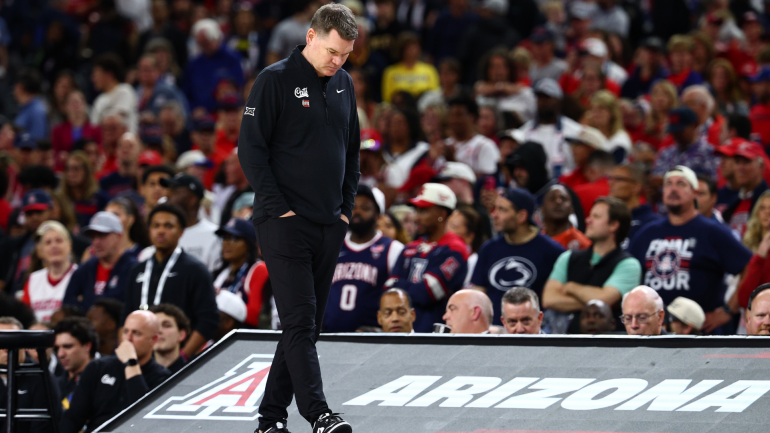
INDIANAPOLIS -- Arizona's fatal flaw finally caught up to it, on the biggest stage.
The talking points about Arizona's 3-point shooting -- or lack thereof -- had been placed on the back burner because the Wildcats were good in almost every other aspect of the game. It didn't matter that Arizona ranked No. 359 in 3-pointers attempted among all Division I teams because its style of bullyball worked almost every team this season.
That was, until Saturday night in Lucas Oil Stadium, when Arizona ran into Michigan.
During Arizona's 91-73 loss to No. 1 seed Michigan in the national semifinals, the Wildcats ran into a better version of themselves. The Wolverines can do almost everything Arizona can, but the difference between a team playing for the title on Monday night against UConn and taking a one-way flight home was that one super-sized team couldn't find a bucket.
"They played with a little bit more of an edge as we did in the first couple of minutes," Arizona freshman Ivan Kharchenkov told CBS Sports. "And then they just rolled the deficit. Then in the second half, we tried to fight back, hit a couple of tough shots."
Downfall on the wings
Michigan finished 12-for-27 from the 3-point line, while Arizona shot 6-for-17. The efficiency from beyond the arc wasn't the problem against Michigan or throughout the season. In fact, Arizona ranked No. 37 among all Division I teams in 3-point field goal percentage (36.7%) as a team entering Saturday.
Arizona's downfall was that it didn't take enough 3-pointers. But with the way this season went, it didn't have to. Arizona trailed by 10 points or more only five times this season and won all five of those games. The Wildcats trailed by as many as 30 points against Michigan. It was a mismatch from almost the jump, as Arizona's previous largest deficit (12 points) of the entire season was matched during the opening minutes.
| Category | Stat | Rank |
|---|---|---|
| 2-pointers | 934 | 1st |
| 2-point % | 55.2% | 69th |
| Free throws | 750 | 1st |
| Free‑throw % | 73.5% | 142nd |
| 3-pointers | 223 | 326th |
| 3-point % | 36.7% | 37th |
That wasn't helped by a style of play not built for comebacks.
"We couldn't find open looks," Arizona center Motiejus Krivas told CBS Sports. "On the defense, we lacked some awareness. When you let a team like that get a (big) lead, it's really hard to come back. ... (Michigan) had a really good game plan on defense. We couldn't adjust to it, and that's why we lost."
The Wildcats can at least sympathize with Saturday's other national semifinal loser, Illinois, because its biggest flaw also came back to haunt them. Illinois' biggest weakness was its inability to create turnovers, ranking last in the nation in steal rate. When it needed a stop down the stretch to make things interesting, Illinois couldn't make it happen. The Fighting Illini forced just four turnovers against UConn.
For as dominant as Arizona was this season, a blowout loss against Michigan is a cruel twist of fate. The Wildcats had a seemingly perfect roster blend of depth, top-end talent and experience that allowed them to steamroll many opponents en route to winning the Big 12 regular-season and conference titles, then the NCAA West Region. But the signs were there.
In the Elite Eight against Purdue, Arizona knocked down one 3-pointer in the first half and trailed by as many as seven points. Arizona did knock down four 3-pointers after the intermission, but its ability to wear Purdue down low was the reason Arizona was appearing in its first Final Four since 2001.
A lesson for the future
The silver lining is that Arizona solved one of its problems heading into next season. Lloyd is returning to Arizona after North Carolina made a strong push to have him succeed Hubert Davis. He signed an extension on the eve of the clash against Michigan, giving the program a much-needed boost of stability after weeks of non-answers for whether Lloyd would stay or go to Chapel Hill.
To get here, Arizona will need to adapt. There are plenty of stay-or-go roster decisions looming for Lloyd, including whether or not Koa Peat and Krivas will return to school and bypass the NBA Draft. Big 12 Player of the Year Jaden Bradley and backup big man Toby Awaka out of eligibility, and Brayden Burries is a projected lottery pick in the NBA Draft this summer, while Peat and Krivas also could be top 20 selections.
Lloyd has shown he can add blue-chip talent from the high school ranks, such as Burries or Peat or go into the transfer portal and add a multi-year starter like Bradley. Arizona's 2026 recruiting class is headlined by five-star guard Caleb Holt, who is a logical shoo-in for Burries next season in the starting lineup. However, Holt's greatest strength is his ability to attack downhill. He doesn't profile as a knock-down shooter.
This game should be a teaching moment for Lloyd. In the modern age of basketball -- where volume 3-point shooting has become a staple -- if you can't shoot, good luck trying to take down a giant like Michigan.
"We didn't make shots earlier," Arizona guard Anthony Dell'Orso said. "Obviously, (we) didn't get off to a great start, they did. Jumped us a little bit and made the hole early. We tried to stay with it. ... It was a tough day. We couldn't get much flowing."
That's why Arizona's season is over.