NCAA will continue tampering investigations despite Big Ten's request for moratorium
The Big Ten wants clearer guidelines on tampering after the NCAA sent out a memo promising strict punishment for rule breakers

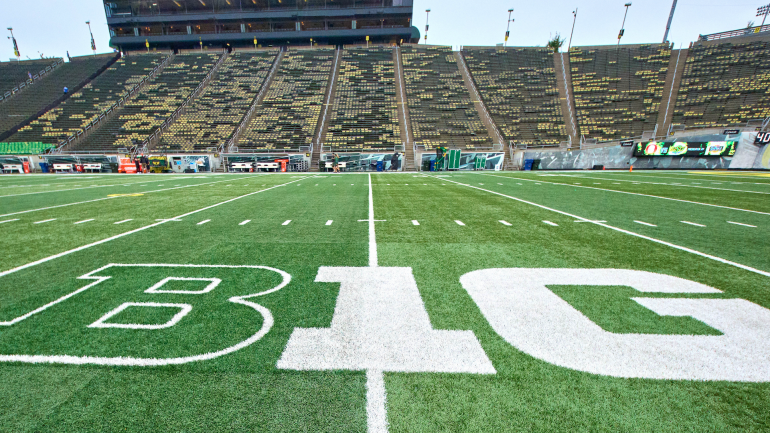
The NCAA responded to the Big Ten's request to end "investigations and infractions proceedings" associated with tampering until there's a better understanding of what constitutes breaking the rules in recruiting. The Big Ten sent a letter, obtained by ESPN, asking that the NCAA reconsider its position on tampering. In a statement provided to Yahoo Sports, the NCAA said it will continue its investigations into potential tampering violations.
"There have been no changes to tampering rules, and there is no moratorium on enforcement activity for possible tampering violations," the statement reads. "Any changes to the infractions process -- or a moratorium on enforcement of certain rules -- would need to be approved by the Division I Board of Directors."
In the wake of the NCAA's recent memo to schools announcing that the Division I Board of Directors has informed its staff to "pursue significant penalties" against tampering offenders, the Big Ten argues that current rules are outdated and from an era when paying players and rampant transfers were not part of the college football landscape.
The Big Ten said in its letter that tampering rules "cannot be credibly or equitably enforced" and believes new rules should be written before penalties are assessed.
"These rules were not designed for a world in which student-athletes are compensated market participants making annual decisions with significant economic consequences," the letter reads. "The collision between the old rules and new reality is producing outcomes that harm the population that the rules were designed to protect."
Power Four conferences weigh in
In a message to Yahoo Sports on Thursday, Big 12 commissioner Brett Yormark said his conference is "adamantly opposed" to pausing tampering investigations for potential violations, but is willing to discuss rules changes.
ACC commissioner Jim Phillips sent the following statement to Yahoo Sports this week after the Big Ten's suggestion to the NCAA:
"As we continue to move forward in the critically important areas of modernizing collegiate athletics, it is imperative that we remain focused on enforcement and building the necessary rules and penalties through work with the NCAA. We are in an environment like no other, and we consistently hear from our coaches and administrators that tampering enforcement must be prioritized. The ACC is dedicated to a thorough review of the current contact rules, but in light of the most recent transfer portal and the very public examples of clear tampering and blatant interference with contractual commitments, I do not agree that all tampering investigations should be suspended."
Last month's heavy-handed announcement on tampering penalties from the NCAA came after Clemson coach Dabo Swinney accused Ole Miss and Pete Golding of tampering with transfer portal signee Luke Ferrelli. Ferrelli re-entered the transfer portal and committed to Ole Miss after initially landing at Clemson.
"We have a broken system, and if there are no consequences for tampering, then we have no rules and we have no governance," Swinney said.
Within a screenshot of the memo posted on social media, Jon Duncan -- the NCAA's vice president of enforcement -- identified tampering as falling under the label of "communications of any kind are not permitted with a student-athlete at another school -- or any other representatives of their interests, including agents -- before that student-athlete entered the NCAA transfer portal."
Swinney said he previously warned the Rebels that he would blow the whistle on what he considered under-the-table recruiting if Golding and Ole Miss failed to back off the former California linebacker, who signed with Clemson on Jan. 7 and moved from the West Coast to South Carolina four days later.
Swinney alleged that Golding texted Ferrelli a photo of a "$1 million contract" and asked about his buyout at Clemson.
This offseason, several programs have sued former players for breach of contract relating to buyouts, along with various coaching staffs being accused of tampering with former players after leaving jobs for a new school.
The Big Ten produced numbers from the 2026 portal cycle -- the first with a January window -- indicating many athletes entered college football's free agency market with do-not-contact tags, meaning there had to be some sort of contact before the permissible period of recruiting.
The conference essentially argued to the NCAA that there's simply too much current gray area in portal recruiting and player compensation to authentically be able to come down on a college football program for a tampering violation.
"The system of college sports is under tremendous stress, both internally and externally. Systems adapt or they break," the Big Ten's letter states.